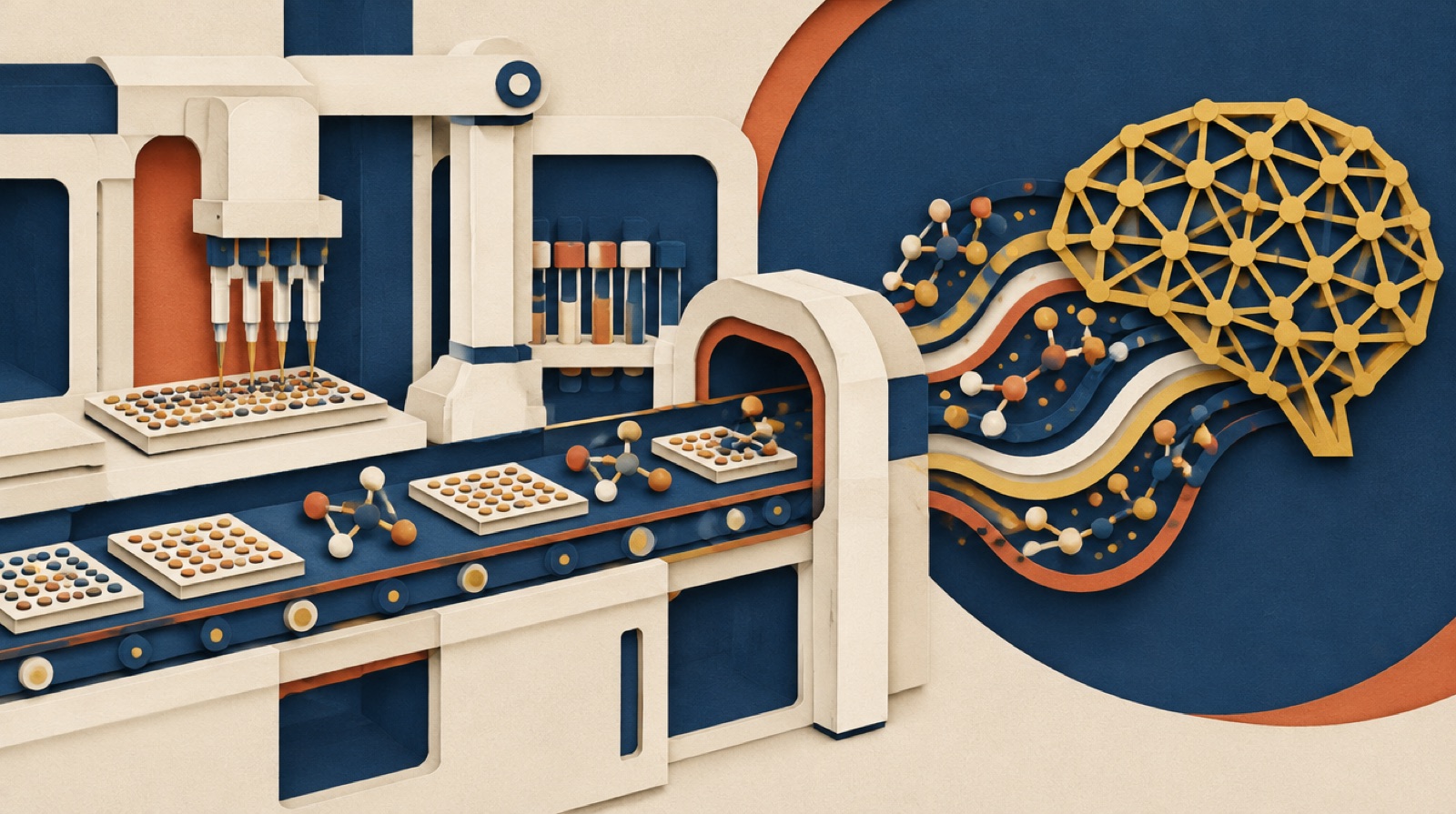

While most AI drug discovery companies sell a model, Leash Biosciences is selling the classroom.
On Nov. 24, the Salt Lake City company1 announced an $11 million financing co-led by Innovation Endeavors and Insight Partners, HIT Consultant reported2. The money will expand its automated laboratory and the virtual environments it uses to train and test AI agents that do science. The report did not name the round type or give a valuation.
The bet matters beyond one startup because it runs against the field's dominant assumption. Much of the money in AI for drug discovery has gone into bigger models trained on published papers and old screening results. Leash argues those data were collected to find drugs, not to teach machines, and that models trained on them learn shortcuts. If it is right, data producers gain bargaining power over model builders. The open question is whether an $11 million company can produce data fast enough to matter.
Leash's lab output so far
| Label | Value |
|---|---|
| Proprietary molecules designed and screened | 6.3M |
| Protein targets tested | ~1,000 |
| Experimental measurements | 44B+ |
| Agent-run campaigns in Minos's first six weeks | ~100,000 |
Source: Leash Biosciences, via HIT Consultant (Nov. 25, 2026)
A factory that makes data on purpose
Leash runs a robotic wet lab, a physical laboratory where chemistry and biology happen in test plates rather than on a screen. It has designed and physically tested 6.3 million proprietary molecules against nearly 1,000 protein targets, producing more than 44 billion measurements of whether and how they bind.
The point is uniformity. Published results come from thousands of labs using different methods, which makes them noisy for a model to learn from. Leash generates every measurement the same way, so a model can learn the chemistry of binding instead of memorizing which molecules happened to be reported as hits.
Most companies developing AI for drug discovery rely on scientific data that was collected to find a drug, not to train models. We are creating a school for AI scientists by generating data for their curriculum.
Ian Quigley, CEO and co-founder, Leash Biosciences
Minos caught frontier models making a scientist's mistakes
In October, Leash launched Minos, a suite of virtual research environments built on its lab measurements. An AI agent picks an experiment, sees the real result Leash already measured, and revises its hypothesis, all at computer speed rather than lab speed.
In the first six weeks, agents ran roughly 100,000 independent experimental campaigns. The company says the runs exposed flaws in leading frontier models: they kept pursuing unproductive paths and failed to change strategy when the evidence contradicted their assumptions. Leash released a preprint, selected environments and thousands of agent narratives, and says it will publish results showing models improve after training in Minos.
That last claim is the one to watch, because Leash has shown the problem but has not yet shown, in public, that its data fix it.
Leash has been arguing this since 2024
The company's own news page3 tracks the thesis. Leash launched in April 2024 with a $9.3 million seed round and a public Kaggle competition, BELKA, built on what it called the biggest public molecule-protein interaction dataset. In August 2024 it reported that computers in the contest could memorize but not create drugs, a result Endpoints News summed up with the line that no one did well. In October 2025 it signed a multi-target agreement with Monte Rosa Therapeutics.
How Leash got here
| Label | Value |
|---|---|
| Apr. 2024 | Seed round and BELKA: $9.3 million seed and a public Kaggle binding competition |
| Aug. 2024 | Contest results: Leash reports models memorized binding data but did not generalize |
| Oct. 2025 | Monte Rosa agreement: Multi-target deal with Monte Rosa Therapeutics |
| Oct. 2026 | Minos launches: Virtual research environments for AI agents |
| Nov. 24, 2026 | $11 million raise: Co-led by Innovation Endeavors and Insight Partners |
Source: Leash Biosciences news page
The round is modest by the standards of AI drug discovery. Leash is not trying to take molecules through clinical trials on this money. It is trying to become a supplier to the companies that build AI scientists, which is a business with lower capital needs but an unproven price for data.
What to watch next
- Follow-on Minos results showing whether models trained in its environments outperform untrained ones.
- Commercial deals with AI labs or drugmakers that pay for access to Leash's data or environments.
- More partnerships like the 2025 Monte Rosa agreement that put its data to work on real targets.
- A larger round, if the training results land, given how small $11 million is for a data factory.